

History
marco piezo technology - from the beginnings to today
The history: First patents and the basis with piezo disks
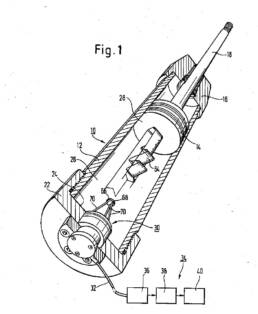
The story begins early: the company founders had already been working on an ultrasonic length measuring system (ULM) for a binding adjustment device (BEG) since 1979. In the early 1980s, the founders of marco registered their pioneering patents for ultrasonic length measurement:
- DE 3031980 A1 (1980): Ultrasonic length measuring system (ULM) in hydraulic cylinders
- US 4,542,652 (1985): Ultrasonic length measurement with reference distance
This laid the foundation stone: Ultrasonic measurement with piezoelectric technology. The piezo disks purchased at that time formed the heart of the systems and were the starting point for everything that followed later - a milestone for today's marco piezo technology.
1982: Company foundation
In April 1982, four entrepreneurs founded MARCO Systemanalyse und Entwicklung GmbH.
Pioneering innovations of the 1990s
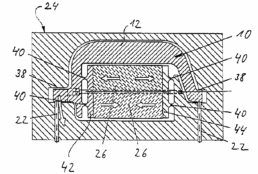
1992 in June: Double stack
marco has the idea for a temperature-compensated piezo actuator and applies for patent DE 42 20 177 A1. It describes a device with which a valve can be actuated precisely and reliably. The special arrangement of two piezo elements and a lever mechanism results in a compact design with a fast and precise switching movement.
1992 in August: Integration of our own piezoceramic development
A new chapter began in 1992 with the integration of TRIDELTA's piezo ceramic development department in Hermsdorf. Hermsdorf had been a center for technical porcelain and ceramics since the 19th century, and later also for piezo ceramics - an ideal environment for this further development.
In August 1992, marco integrated the piezo material development and application technology department. This step was technologically decisive: it marked the beginning of the development of marco Piezotechnologie, which turned the pure purchase of piezo disks into an in-house piezo ceramic and product development and production department.
1994: Basics for modern stack actuators
In 1994, marco laid the foundations for modern stack piezos and stack actuators. The actuators have a new type of contacting technology specially developed by marco, which has significantly increased their service life. The operating voltage has been reduced to an easily accessible 400 V.
As a result, marco piezo technology has continued to develop in the direction of durable and practical actuators.
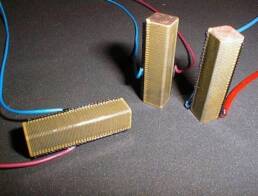
1998: The Torque Block is created
Piezo stacks show problems with durability, so the Torque Block® is developed. With its further development and the granting of a patent in 1998 (DE 196 46 511), marco lays the foundation for the success of its dispensing valves. Based on this invention, a complete dispensing system was developed over the years that covers the entire process - from the dispensing valvewith a suitable insert, material preparation and storage, feeding, precise application and integration into the production line with the marco Gantry Systems series.
2012: The breakthrough
After decades of development work, the breakthrough came in 2012: marco successfully established itself as a specialist for piezo in sensors, actuators and components. This turned the long years of development into a sustainable success story.
Today: Broad product range - from medical technology to solar panels for satellites
Today, marco impresses with an impressive variety of piezoceramic solutions. The portfolio of marco piezo technology ranges from applications in medical technology to solar panels for satellites and impressively demonstrates the versatility of the technology:
- Torque Block® is the drive of the marco high-precision dosing valve
- The marco bubble sensor detects air bubbles in liquids with a flow diameter of less than 100 µm
- Ultrasonic parking sensor for a premium German car brand
- Sensors for detecting aquaplaning under the name SHAKE
- Structure-borne sound sensors for detecting material fatigue, e.g. in wind generators
Overview of our piezoceramic materials
- FPM 110 is a hard piezoelectric material with a narrow hysteresis and very high mechanical quality. Particularly noteworthy is the exceptionally high piezoelectric charge constant for hard materials. It is designed for the power ultrasonic range, but is also used in sensors in multilayer technology.
- FPM 231 is a soft material with very high deformation (S₃ = 0.19 % at 2 kV/mm), low mechanical properties and a high relative dielectric constant. Its outstanding piezoelectric charge constant makes it the ideal material for actuators, especially for Torque Block® applications, bending actuators and multilayer stacks.
- FPM 202 is a piezoelectrically soft material with high electromechanical coupling factors and a low relative dielectric constant. It has a high charge and pressure constant and can also be used in the extended temperature range thanks to its high Curie temperature. Typical applications are Air ultrasonic transducers, modular transducers as well as force and acceleration sensors.
- Despite its high Curie temperature and low dielectric constant, FPM 203 has a very high deformation (S₃ = 0.18 % at 2 kV/mm). It can therefore be used for actuators that operate in the higher temperature range. This material is ideal for Torque Block® applications, but - similar to FPM 202 - it can also be used in ultrasonic applications.
- FPM 240 is a material that was specifically developed for bending actuators. Due to a higher planar coupling factor and a lower x-y linkage of the stiffness tensors, greater deflections and forces can be achieved than with the similar material FPM 231.
System analysis and development as a successful concept
marco is a medium-sized family business in which several families are involved. Successfully active on the world market, development and production are exclusively in Germany. Thanks to our interdisciplinary team and innovative solutions, we set standards worldwide. Piezo ceramics from marco prove their strength particularly in the field of complete dispensing systems - whether for dispensing solder pastes, applying silicone lensesor solar cells for space.
Precision and reliability result from the interaction of system analysis, development and marco piezo technology.
Headquarters
marco System Analysis and Development GmbH
Hans-Böckler-Strasse 2
85221 Dachau
Germany
Phone: +49 8131 5161-0
Fax: +49 8131 5161-66
info@marco-systems.com