

Dispensing High-Viscosity Fluids: Precise, Clean, and Process-Stable
Precise dosing of high-viscosity fluids requires more than just the right data sheet values. The key factor is how much usable energy actually reaches the fluid so that a clean droplet forms and reliably detaches from the nozzle.
This is precisely where a key requirement in precision dispensing lies: The drop must not only form, but also detach cleanly from the nozzle at the right moment. If this drop detachment is consistent, residue at the nozzle tip can be reduced, material buildup can be prevented, and reproducible dispensing results can be achieved.
To ensure stable dispensing of highly viscous fluids, several factors must work together: viscosity, energy input, droplet detachment, nozzle geometry, temperature control, and process parameters. A single mPas value is therefore rarely sufficient to reliably assess dispensability.
Dispensing High-Viscosity Fluids


Why Valve Technology Is Crucial
With highly viscous fluids, what matters is how much usable energy actually reaches the fluid. This depends not only on the driving force or pressure, but also on the interplay of valve mechanics, system rigidity, sealing design, temperature control, nozzle geometry, and parameter settings. The technical insight into improved dispensing of high-viscosity material demonstrates how marco has further developed valve technology for such materials with the SJet Power valve. It explains the role that valve mechanics, nozzle geometry, media velocity, and droplet detachment play in ensuring a stable dispensing process.
Why High-Viscosity Materials Are Difficult to Dispense
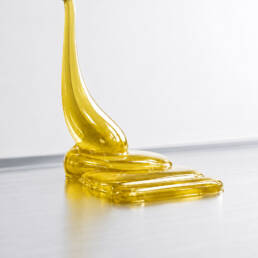
High-viscosity fluids behave more sluggishly than low-viscosity liquids. They offer greater resistance to acceleration and require more energy for a droplet to detach cleanly. This task becomes particularly challenging with small droplets. As miniaturisation increases, the ratio of surface area to volume rises. As a result, surface tension and wetting become increasingly important. Surface tension holds the droplet together and influences how easily it detaches from the nozzle. Wetting describes how strongly the fluid adheres to or spreads across the nozzle tip. The stronger these effects are, the more difficult it can be to achieve a clean droplet detachment.
Focus on Process Stability
Ultimately, what matters to users is not a single parameter, but rather how the process behaves in real time: clean dispensing points, less material buildup at the nozzle, consistent repeatability, and a controllable process window.
Stable dispensing can be crucial—especially for adhesives, hot-melt adhesives, two-component materials, or curing media—in terms of quality, cleaning requirements, and process reliability.
Whether a fluid can be dispensed appropriately should therefore always be evaluated by considering the interaction of the material, valve technology, temperature, nozzle, and process parameters.
Can your high-viscosity fluid be dispensed consistently?
Whether a high-viscosity fluid can be dispensed reliably does not depend solely on the viscosity value listed in the data sheet. What matters is how it actually behaves during the dispensing process.
marco supports you with the technical assessment of your application and the design of a suitable system.
Please send us your inquiry.