

Why High-Viscosity Materials Are Difficult to Dispense
High-viscosity materials pose special challenges in microdispensing. It is not only crucial to dispense a defined amount through a nozzle onto a substrate; the material must also form a clean, reproducible drop or a uniform line.
The more viscous a material is, the more sluggishly it responds to acceleration. The dispensing system must apply more energy to initiate material flow, force it through the nozzle, and ensure clean separation afterward. If this separation is not achieved reliably, material residues remain on the nozzle. The result is material build-up, inconsistent dispensing results, and reduced repeatability.
Why Droplet Separation Is So Critical
Droplet separation is the moment when the dispensed material detaches from the nozzle tip. With low-viscosity liquids, this separation is generally easier because the material flows more readily and offers less resistance to motion.
The situation is different with high-viscosity fluids. The material reacts more sluggishly, may form strings, or stick to the nozzle tip. As a result, the droplets are less clearly defined. Residue on the nozzle can affect subsequent dosing and destabilize the dosing pattern over time.
For users, therefore, it is not just important whether a drop can be produced. What matters most is whether the drop detaches cleanly and consistently and whether the process remains stable over time.
Small drops make the challenge even tougher
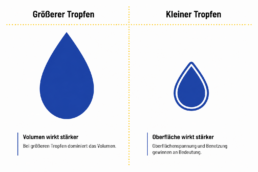
Dispensing high-viscosity materials becomes even more demanding when working with small dispense volumes. As components continue to be miniaturized, the surface-to-volume ratio increases, making surface tension and wetting behavior significantly more influential.
Surface tension holds the droplet together and affects how easily it detaches from the nozzle. Wetting describes how strongly the material adheres to or spreads across the nozzle tip. The stronger these effects are, the more difficult it can be to achieve a clean droplet separation.
Small droplets are not simply scaled-down versions of larger ones. At very low dispense volumes, the balance of forces changes. Effects that are of minor importance at larger dispense volumes can become critical.
In micro-dispensing, this means that the smaller the required dot or the finer the line, the more precisely the material, nozzle, valve motion, temperature, and process parameters must be matched.
Is Your Material Not Separating Cleanly from the Nozzle?
If high-viscosity fluids leave residue on the nozzle tip, form strings, or produce inconsistent dot sizes or line patterns, it is worth conducting a technical evaluation of the dispensing process. marco analyzes how the material, nozzle geometry, temperature, and process parameters influence dispensing performance.
Datasheet Values Only Partially Reflect Real Process Behavior
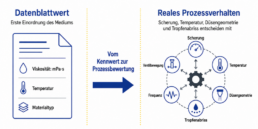
In data sheets, viscosity is often specified as a numerical value, for example, in mPa·s. While this provides a useful initial reference, it is often insufficient for evaluating real-world dispensing performance.
Many materials exhibit shear-thinning behavior, meaning their viscosity decreases under actual dispensing conditions—for example, when the material is forced through a narrow nozzle or accelerated inside the dispensing valve. As a result, a high mPa·s value on paper does not necessarily indicate how challenging a material will be to dispense in practice.
Conversely, a material with a seemingly moderate viscosity can still present significant challenges if it adheres strongly to the nozzle, forms strings, or is highly sensitive to temperature variations. What ultimately matters is the material's actual behavior under process conditions, where material properties, nozzle geometry, temperature control, and dispensing valve technology all interact.
Data sheet value available, but dispensing capability still undetermined?
A viscosity value in mPa·s is a useful starting point, but it does not fully describe how a material will behave during the dispensing process. What matters is how the material responds to shear, temperature, and real-world process conditions.
Temperature Influences Dispensing Performance
For many high-viscosity materials, temperature plays a critical role. As the temperature increases, viscosity often decreases. The material flows more easily and can be accelerated more effectively. Especially when dispensing hot melt adhesives, precise temperature control can be a key factor in achieving clean droplet separation.
At the same time, the temperature must remain stable throughout the process. If the material cools too much at the nozzle tip, its viscosity can increase again. As a result, droplet separation becomes less reliable, material residues are more likely to form, and dispensing quality may become inconsistent.
Temperature is therefore more than just a means of reducing viscosity. It is an active process parameter that directly influences viscosity, droplet formation, and overall process stability.
Why Single Droplets and Low Dispensing Frequencies Can Be Challenging
Not every application operates at high dispensing frequencies. During single-shot dispensing or at low cycle rates, the material has more time to accumulate at the nozzle tip or spread across its surface. This can influence the characteristics of the next droplet.
With hot melt materials, an additional challenge arises: the material at the nozzle tip can cool between dispensing cycles. This increases the local viscosity, making clean droplet separation more difficult and increasing the likelihood of material residues.
An unstable droplet separation is therefore not solely a material-related issue. It also depends on the interaction between the material, nozzle geometry, valve motion, temperature, and process parameters.
What Users Should Evaluate When Dispensing High-Viscosity Materials
To achieve stable dispensing of high-viscosity materials, the application should always be evaluated as a complete system. Individual material properties can provide useful guidance, but they cannot replace an assessment of the material's behavior under actual process conditions.
Key questions include:
🔹What is the viscosity specified in the datasheet?
🔹Does the material's behavior change under shear or with temperature?
🔹What droplet, dot, or line size is required?
🔹What frequency or clock speed is required?
🔹Are there any residue, strings, or material buildup on the nozzle?
🔹What are the cleaning and process requirements?
The answers to these questions help determine whether a material is fundamentally suitable for dispensing or whether the dispensing valve technology, nozzle geometry, temperature control, and process parameters need to be optimized.
Conclusion: High-Viscosity Materials Require Process Expertise
High-viscosity materials are not simply "thicker" liquids. They fundamentally change the requirements of the entire dispensing process. More energy is required to accelerate the material, droplet separation becomes more critical, and small dispense volumes are more sensitive to surface tension, wetting behavior, and temperature.
For this reason, it is not enough to rely solely on the viscosity value listed in the datasheet. What truly matters is the interaction between the material, nozzle geometry, valve motion, temperature, and process parameters. Many of these influencing factors can be optimized through careful process design.
Would you like to know if your medium can be dispensed consistently?
Whether a high-viscosity material can be dispensed reliably depends on more than its viscosity value. What matters is its actual behavior under real dispensing conditions.
marco supports you in evaluating your application and selecting the right dispensing system configuration.
Related Topics
Dispensing Valve Technology for High-Viscosity Materials
The technical deep dive explains how marco has advanced its dispensing valve technology to achieve cleaner, more stable dispensing of high-viscosity materials.
Technical Verification of Dispensing Performance
The article on technical verification explains how dispensing performance can be evaluated using benchmark materials, high-speed imaging, and droplet exit velocity.
Demonstrating Dispensing Capability: Benchmark, High-Speed Measurement, and Real-World Examples