

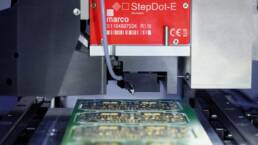
Precise Solder Paste Dispensing for Fine Structures
Solder paste can be dispensed precisely onto fine structures when dot size, volume and position are adapted to the individual pad geometry. This is particularly relevant for small pads, fine pitch and miniaturized SMT PCBs where stencil printing can reach its process limits.
Do you need to apply solder paste precisely onto small pads or fine structures?
Talk to us about your application – together we can evaluate which dispensing solution fits your process.
Precise solder paste application for small pads, fine pitch and miniaturized PCBs
The smaller pads and PCB structures become, and the finer the pitch, the more precisely solder paste needs to be dispensed. As miniaturization continues to advance in electronics manufacturing, solder pads become smaller, spacing becomes tighter and permissible tolerances decrease. What still works reliably on larger pads can quickly lead to bridging, missing solder paste dots, satellites or uneven wetting when applied to fine structures.
Solder paste dispensing offers greater flexibility in this context. Unlike stencil printing, solder paste application is not tied to a fixed stencil apertures. Instead, defined dispensing dots are generated. Dot size, volume and position can be precisely adapted to the respective PCB structure.
For this purpose, marco develops coordinated system solutions consisting of the StepDot dispensing head, the marc3 Gantry System, software, camera technology and process know-how. The technical challenge is not only to generate small solder paste dots, but to apply them to the PCB reproducibly and with process reliability under real production conditions.
Why fine structures make solder paste application more challenging
In solder paste dispensing, solder paste is applied to the solder pad as a precisely defined dispensing dot. Dot size, volume and position are adapted to the respective pad geometry. This allows a small pad to be supplied with a smaller amount of solder paste, while other areas within the same layout can receive a different volume.
The key factor is the interaction between dispensing head, motion platform and process control. The StepDot Dispensing Head generates the dispensing dot, while the marc3 Gantry System positions the StepDot precisely over the PCB. Camera system and software support the evaluation of the ongoing process.
What the marco solution enables for fine structures
When dealing with small soldering areas, tight pitch, and variable pad geometries, precise dispensing points, flexible volumes, and a stable overall process are particularly important.
Mastering fine structures
Precise dispensing dots even on small solder pads and with tight spacing.
Flexible dot sizes adjustment
Different volumes can be applied selectively during the ongoing dispensing process.
Stable process control
Volume repeatability, low susceptibility to errors and reproducible results under demanding conditions.
A system instead of a single component
StepDot Dispensing Head, marc3 Gantry System, software, camera technology and process know-how work together precisely.
Typical applications for fine structures
Dispensing is particularly suitable for SMT applications where small geometries, variable paste volumes or high repeatability requirements come together:
🔹 Assemblies with very fine pitch and small solder pads
🔹 Critical pads as a supplement to stencil printing
🔹 Layouts with varying pad sizes and solder paste volumes
🔹 Partially assembled PCBs, for example in repair stations
🔹 Miniaturized SMT assemblies with tight tolerances
This makes dispensing especially suitable for areas where solder paste application needs to be selectively adapted to individual structures.
Key requirements for solder paste dispensing
When working with fine structures, the challenge is not simply to apply a small amount of solder paste. What matters is that every dispensing dot remains repeatable in terms of shape, position and volume.
Important requirements include:
🔹 Small solder paste dots with a stable height-to-diameter ratio
🔹 Reliable volume repeatability
🔹 Precise positioning on small pads
🔹 No bridging with fine pitches
🔹 No satellites or unwanted paste residues
🔹 Variable dot sizes for different pad geometries
🔹 Inspection of small volumes during the ongoing process
In the context of dispensed solder paste dots, the height-to-diameter ratio describes how stable and well-defined an individual dot is. A cleanly formed dot supports subsequent wetting and reduces the risk of process errors.
From the dispensing head to dispensing cell
For fine structures, a precise dispensing head alone is not enough because small solder paste dots must be positioned accurately, monitored and kept stable over many repetitions.
The StepDot Dispensing Head from marco is designed for the precise dispensing of the smallest solder paste volumes.
The StepDot Dispensing Head is a dispensing head that combines high-speed needle dispensing with high precision. The piezo-controlled movement of the nozzle enables controlled application even with very small volumes. This allows for minimum dot sizes of 120 µm and dot spacings of 300 µm or less.
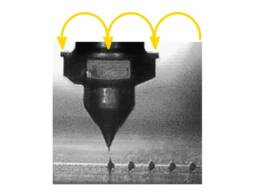
The marc3 Gantry System provides the matching motion platform and can be integrated into different production environments as a modular dispensing cell.
What matters is the precise interaction between dispensing head, motion platform, software, camera system and process parameters. Only this combination creates a robust manufacturing process for fine structures.
Technical capabilities for fine structures
The following technical specifications are particularly relevant when applying solder paste small pads, fine-pitch components, and miniaturized PCB structures.
| Technical capability | Relevance for fine structures |
|---|---|
| Minimum dot size of 120 µm | Suitable for very small solder paste dots |
| ±15 µm placement accuracy | Enables precise application even on small structures |
| On-the-fly volume analysis | Continuous evaluation of the dispensing process |
| Up to 100 Hz dispensing frequency | Enables high dynamics in the dispensing |
| Dot spacing of 300 µm and less | Enables process-reliable dispensing even with tight geometries |
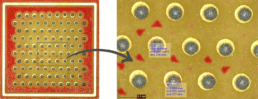
Would you like to know whether your geometry can be dispensed?
Send us your requirements for pad size, pitch and paste volume – we will review the technical feasibility.
Process reliability for small solder paste dots in an 8-hour endurance test
The smaller the solder paste dot, the more important process control becomes. Even minor deviations in volume, position or dot shape can directly affect the subsequent soldering result. This means the dispensing process must not only start with precision but also remain stable throughout operation.
marco combines dispensing with camera technology, analysis and process control. In an 8-hour endurance test, stable solder paste dispensing was demonstrated under continuous operating conditions. The test shows that the key requirement is not a single precise dot, but reproducible results over many dispensing cycles.
Precision solder paste dispensing as a system solution for fine structures
For applications with fine structures, small solder pads and demanding pad geometries, marco offers a coordinated solution consisting of StepDot Dispensing Head, marc3 Gantry System, software, analysis and process know-how.
The result is not an isolated individual component, but a reproducible dispensing process for applications where conventional methods such as stencil printing, reach their process limits.
Talk to us about your application. Together, we’ll find the right solution.