

Precise Dispensing of 2K Silicone for Mini-LED Lenses
Symmetrical lens geometries, bubble-free material processing, and high throughput
In Mini-LED applications, the dispensed material performs several functions simultaneously: the 2K material forms an optically effective lens, evenly diffuses the LED’s light, and protects the component from external influences.
To ensure that the desired optical properties are reliably achieved, the material must be mixed homogeneously, positioned precisely, and applied with reproducible geometry. Even minor deviations in the mixing ratio, dispensing volume, or lens shape can affect the light distribution and the quality of the final product.
Marco develops integrated solutions that combine material preparation, two-component mixing technology, precise dispensing, camera-based position detection, and dynamic automation.
Optical Function and Protection in a Single Material
The two-component silicone is dispensed directly onto the individual mini-LEDs. After curing, each drop forms an optical lens that diffuses the light as evenly as possible in all directions. At the same time, the material encapsulates the LED. This protects the component from external influences and contributes to a long service life.
The optical properties are inherent in the material itself. Therefore, a homogeneous mixture of both components in the specified ratio is essential for consistent results.
Why The Shape Of The Lens Is Crucial
During application, each lens must form evenly and symmetrically. This is particularly challenging because the movement of the dispensing head can affect the freshly deposited drop. Under unfavorable conditions, the material tends to shift to one side, resulting in an asymmetrical lens geometry.
To ensure a stable process, several parameters must be coordinated:
- Material exit velocity
- Material and Nozzle Temperature
- Dosing Time and Valve Parameters
- Motion Profile of the Dosing Head
- Distance between the nozzle and the workpiece
These factors are examined in extensive laboratory tests and adapted to the specific material. This results in a defined process window within which the lenses can be fabricated in a reproducible and symmetrical manner.
Volumetric 2K mixing, even with extreme mixing ratios
For the silicone to function optically, both components must be mixed homogeneously and processed in the ratio specified by the customer. Even slight deviations can affect curing, material properties, and thus the optical result.
The marco 2K mixing head measures both components volumetrically and combines them in a controlled manner. This allows even extreme mixing ratios, such as 20:1, to be achieved precisely and reproducibly, depending on the material and application.
Since the components are mixed only immediately before dispensing, only a limited amount of mixed material is present in the process. This limits the influence of the drip time to the path between the mixing head and the material application point.
Material Preparation for Lenses Without Air Bubbles
Air bubbles inside the lens can alter light scattering and impair optical quality. Preventing air entrapment therefore begins even before the actual dispensing process.
Both material components are degassed in tanks and then transported via the marco PushMembrane to the mixing and dispensing system . This material supply minimizes the re-entry of air into the prepared material.
The degassed silicone can also absorb small amounts of residual gas found, for example, in cavities beneath or adjacent to the LED. Within the defined process window, this allows for the production of lenses without visible air pockets.
Camera-based positioning on each LED
A uniform lens can only reliably fulfill its optical function if it is positioned centrally on the LED. However, manufacturing and component tolerances can cause the actual positions to deviate from the nominal coordinates of the board layout.
Before dispensing, a camera system therefore determines the actual position of the LEDs. The dispensing program is adjusted based on this measurement data. The material application is thus guided by the actual component positions and not solely by the theoretical grid.
This supports precise centering of the lenses and reduces the risk of position-related quality deviations.
Multi-head dispensing for short cycle times
In addition to lens quality, the required production throughput is a key factor. Sequential processing of each individual LED row would result in long cycle times for densely populated boards.
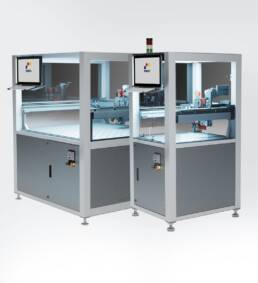
A multihead is therefore used for the Mini-LED application. Multiple valves are arranged in a staggered Y-direction and are guided together over the component on the marc3 gantry system. While the dispensing head moves along the X-axis, multiple LED lines are processed in parallel.
The marc3’s precise motion control ensures that the valves are guided reproducibly to the respective LED positions. Thanks to the combination of the multihead and coordinated axis movement, the dispensing head does not have to approach each row individually.
This reduces additional positioning movements and increases throughput without compromising the controlled shaping of the individual lenses.
Dosing Two Materials in a Single Cycle
In addition to the Mini-LEDs, the board also contains integrated circuits (ICs) that must be encapsulated with a different material to achieve the same longevity. For this encapsulation process, the dispensing head is equipped with an additional fifth valve.
This allows the optical 2K silicone lenses and the IC encapsulation to be completed within a single machine cycle.
This reduces the need for additional process stations, repositioning, and the handling of boards that have already been processed. At the same time, the entire process chain becomes more compact and efficient.
Measurable Quality Control Through Image Analysis
The geometry of the finished lenses can be checked using image analysis. Among other things, this involves evaluating the shadow cast by the lens.
Using a previously validated correlation, a volume-based parameter can be derived from this data. This provides the customer with a measurable process characteristic for quality control.
The evaluation is not based solely on visual inspection. It is possible to verify whether the lens geometry falls within a defined tolerance window.
Benefits of the Integrated Mini-LED Dosing Solution
- Reproducible and symmetrical lens geometries
- Precise and uniform application of two-component silicone—even at extreme mixing ratios
- Minimizing Air Inclusions Through Degassing and Controlled Fluid Supply
- Precise centering of the lenses using camera-based position detection
- High Throughput Thanks to Parallel Multihead Dosing
- Processing Multiple Dosing Media in a Single Run
- Measurable quality control through image-based analysis
- Reduced risk of scrap and rework
Can your 2K optical material be dispensed in a stable and reproducible manner?
We develop system solutions for precision processes that are tailored to your needs—not the other way around. Talk to us—we look forward to taking on your challenge.
Get in touch with us. We will support you on your way to process reliability.