

Process-stable dispensing of high-viscosity materials: measured data and application examples
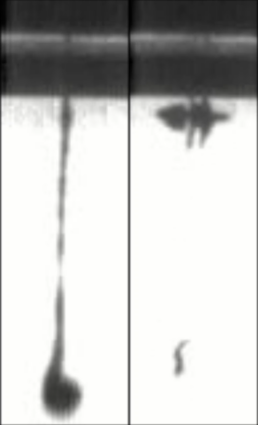
Dispensing high-viscosity materials with precision is significantly more challenging in practice than a datasheet might suggest. The more viscous the material, the more energy is required to form a clean droplet in the first place. This is precisely where the challenge lies in microdispensing: the droplet must not only form, but also separate reliably from the nozzle. If this does not happen cleanly, material residues remain on the nozzle. The result is an unstable process in which dispensing quality gradually deteriorates over time.
This becomes particularly critical in applications involving individual droplets or low dispensing frequencies. In these cases, the material has more time to spread around the nozzle. With hot melt materials, there is the additional challenge that the material may already begin to cool again at the nozzle tip, making clean droplet separation even more difficult. Four factors are therefore particularly important: viscosity, energy input, droplet separation, and process stability.
How Marco Solves This
For high-viscosity materials to be dispensed cleanly, adjusting a single parameter is not enough. What matters is the interaction between valve mechanics, energy input, and process design. This is exactly where marco’s further development efforts are focused. The goal was to transfer more energy into the droplet, improve droplet separation, and thereby achieve a more stable process even with demanding materials.
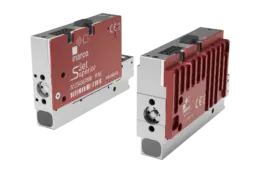
A key step was increasing the structural rigidity of the SJet Power Valve compared with the SJet dispensing valve. The addition of a fixed rear wall significantly increased the stiffness of the housing. This alone improves dispensing performance because less energy is lost within the system. In the SJet Power Valve, the TorqueBlocks, which generate the actual force, were also reinforced. This allows more energy to be transferred into the material—and that is crucial when dispensing high-viscosity materials.
In addition, newly developed drive electronics supply the wider TorqueBlock with sufficient power to dispense even high-viscosity materials at frequencies of up to 500 Hz. The increased drive energy supports a stable and repeatable dispensing process, particularly with highly viscous materials.
Other factors also play an important role in combination: selecting the right process parameters, using a fast closing profile to increase droplet velocity, and choosing the appropriate valve insert. The geometry between the plunger and nozzle also influences how strongly the material is accelerated inside the nozzle. For high-viscosity applications, this acceleration is critical for achieving clean droplet separation.
The SJet mtv/sdm/c valve is suitable for medium- to high-viscosity applications. The SJet Power mtv/bem/c valve is designed for particularly demanding high-viscosity applications that require greater force, greater rigidity, and greater energy transfer during the process.
How Dispensing Performance Was Verified
Anyone looking to dispense high-viscosity materials needs reliable comparative data. This is where many claims in the market fall short: different materials, varying test conditions, and strongly shear-thinning materials make direct comparisons difficult. For this reason, dispensing performance was not assessed solely on the basis of material specifications, but using a benchmark material suitable for reproducible testing: Loctite AA 352, a UV adhesive that was deliberately selected because it is not shear-thinning. This makes it possible to compare the performance of different systems under consistent conditions.
Dispensing quality was evaluated based on droplet exit velocity, measured using a high-speed camera. This parameter is particularly meaningful because it indicates how much energy the valve actually transfers into the droplet. In general, the higher the exit velocity, the more reliably clean droplet separation can be achieved – and the more likely it is that a demanding material can be dispensed with process stability.
Based on this, SJet Power was compared to a standard benchmark valve in an optimized system setup. The comparison is particularly telling at room temperature: SJet Power achieves a droplet exit velocity of 83 m/s, while the benchmark valve reaches 84 m/s. Thus, the comparison shows that SJet Power achieves a performance level comparable to that of the benchmark valve when dispensing high-viscosity fluids.
Practical Examples from the Automotive and Pharmaceutical Industries
High-viscosity materials place demanding requirements on valve technology, drive electronics, and process design. With the right system setup, however, even challenging materials can be dispensed cleanly and reliably. Two practical examples from the automotive and pharmaceutical industries demonstrate this.
In an automotive application, a high-viscosity hot melt material needed to be dispensed with reliable process stability. Initially, the mtv/sdm/c was used to achieve the required frequency with the available electronics. Dispensing was technically possible, but repeated material build-up occurred during the process.
After switching to the SJet Power mtv/bem/c, the dispensing pattern became significantly cleaner. The system operated more stably and was better suited to the requirements of the high-viscosity material. In this setup, achieving the target frequency of 500 Hz was initially limited by the available power of the drive electronics rather than by the dispensing principle itself. Optimized drive electronics for the SJet High-Power Valve are now available, providing sufficient power to maintain a constant dispensing frequency of 500 Hz in applications of this kind.
A similar result was achieved in another application from the pharmaceutical industry involving a highly viscous two-component (2K) material. Here, too, clean dispensing with the mtv/sdm/c was only possible to a limited extent. After switching to the SJet Power mtv/bem/c in combination with the new high-performance mtv/ehm/h drive electronics, the material could be dispensed significantly more stably and precisely in the application.
These examples demonstrate that high-viscosity dispensing is not determined by a single component, but by the right overall system. When the valve, drive electronics, material supply, and process design are properly matched, even demanding materials can be handled reliably. This is exactly where marco comes in – with the right technology, application expertise, and the ability to evaluate materials under real process conditions.
Benefits for Users
For users, the decisive factor is ultimately not a single specification, but the result under real process conditions: high-viscosity materials can be dispensed more cleanly. When droplets separate cleanly, material build-up on the nozzle is reduced. The process remains more stable, even when dispensing individual droplets or operating at lower frequencies. With demanding materials in particular, this is a significant practical advantage.
Another practical benefit is especially important when processing high-viscosity or curing materials: cleaning. marco systems are designed so that the valve insert can be removed, meaning that essentially only the wetted components need to be cleaned. This simplifies handling in applications where materials such as hot melt adhesives can solidify quickly as they cool, making cleaning during production particularly time-consuming.
In addition, the design has been optimized to minimize stroke loss over time. This also helps maintain stable dispensing performance during continuous operation. For users, the main benefits are: cleaner dispensing, easier cleaning, and a more stable process.
Why Dispensing High-Viscosity Materials Is Becoming Increasingly Important
The precise dispensing of challenging materials is becoming increasingly important across many applications. One reason is ongoing miniaturization. As droplets become smaller, achieving clean droplet separation becomes more difficult. The surface-area-to-volume ratio increases, surface tension has a greater influence, and high-viscosity materials respond particularly sluggishly under these conditions. Producing small droplets precisely and repeatably is therefore significantly more demanding than dispensing larger droplets.
At the same time, adhesive bonding is becoming increasingly important in many industries, while components and structures continue to shrink. This further increases the demands placed on precision dispensing. Applications in the electronics and automotive industries demonstrate how closely miniaturization, material requirements, and process reliability are now interconnected.
With the SJet Power Valve mtv/bem/c, an optimized overall system design, and additional power reserves on the electronics side, the application range for high-viscosity materials continues to expand.
Conclusion
Precise metering of high-viscosity fluids is not a matter of a single parameter, but rather the result of an understanding of the material, system stiffness, energy input, and appropriate process design. When these factors come together, even demanding applications can be implemented cleanly and reproducibly. This is precisely what is demonstrated by the further development of the SJet valve mtv/sdm/c into the SJet Power valve mtv/bem/c, the systematic comparative tests, and the successful real-world applications.
For users, this means one thing above all: high-viscosity materials can now be dispensed with significantly greater process stability and in a way that is better aligned with real application requirements.
Would you like to dispense high-viscosity materials with precision in your application?
Talk to us about your requirements. Together, we’ll determine which dispensing system, and configuration best suits your material, application, and process.
FAQ
Why Are High-Viscosity Materials Difficult to Dispense?
High-viscosity materials respond much more sluggishly and require more energy for droplets to form cleanly and separate reliably from the nozzle. This droplet separation is a key factor in determining process stability.
Why Is the Viscosity Value in the Datasheet Often Insufficient?
Many materials are shear-thinning and behave differently under actual dispensing conditions than they do in standardized viscosity measurements. To better assess shear-thinning behavior, a rheometer measurement can be very useful. It can measure, among other things, how viscosity changes as a function of shear rate and temperature. At marco, we also use rheological measurements to better characterize customer materials and tailor the dispensing process more precisely to their specific properties.
What Is the Difference Between mtv/sdm/c and mtv/bem/c?
The mtv/sdm/c is suitable for medium- to high-viscosity applications. The mtv/bem/c is designed for particularly demanding high-viscosity applications and transfers more energy into the droplet thanks to its higher structural rigidity and reinforced piezo blocks.